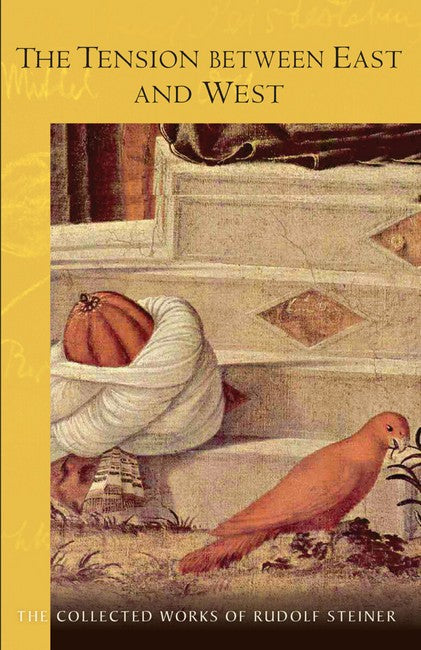
The Tension Between East and West 2/e
The Tension Between East and West 2/e
SKU:9781621483274
Share
This demanding set of lectures attempts to lift the veil from modern social and spiritual problems as experienced in the contrasts between East and West. By ascribing only vague and subjective validity to human thinking, modern science tries to invalidate the very faculty that gives us our human dignity. However, such “unreality” of thought images makes possible the inner freedom that scientific doctrine tends to deny in principle. The need arises from these contradictions to extend the limits of ordinary scientific thinking toward new investigative capacities.
In part one, “Anthroposophy and the Sciences,” Rudolf Steiner explains that this can be achieved in a healthy way through two kinds of meditative exercises very different from yoga and asceticism and ancient paths to higher knowledge. These disciplines lead to the discovery of a paradoxical truth: “If you would know yourself, look into the world. If you would know the world, look into your self."
The spiritual-scientific philosophy thus presented provides a framework through which the second half of the book, “Anthroposophy and Sociology,” considers how a healthy social life can be understood and formed. Today the old social instincts of humanity have grown uncertain, and the rational intellect is proving unsuited to comprehend and foster a truly human social life. While admitting that we are only beginning to discover the right relationship between individual and community, Steiner describes how a conscious spiritual life offers the same social certainties as did the earlier, “instinctual” human life. He explains how we may find a way from our highly developed sense of a personal self toward the global social organism.
When the riddles of existence concern the human soul, they become not only great problems in life but life itself. They become the happiness or sorrow of human existence. And not a passing happiness or sorrow only, but one we must carry for a time through life, so that by this experience of happiness or sorrow we become fit or unfit for life. — Rudolf Steiner
This book is a translation from German of Westliche und östliche Weltgegensätzlichkeit. Wege zu ihrer Verständigung durch Anthroposophie (GA 83, 3rd ed.), Rudolf Steiner Verlag, 1981.
About the Author
About the Author
<p><strong>Rudolf Steiner</strong> (1861–1925) was born in the small village of Kraljevec, Austro-Hungarian Empire (now in Croatia), where he grew up. As a young man, he lived in Weimar and Berlin, where he became a well-published scientific, literary, and philosophical scholar, known especially for his work with Goethe’s scientific writings. At the beginning of the twentieth century, he began to develop his early philosophical principles into an approach to systematic research into psychological and spiritual phenomena. Formally beginning his spiritual teaching career under the auspices of the Theosophical Society, Steiner came to use the term Anthroposophy (and spiritual science) for his philosophy, spiritual research, and findings. The influence of Steiner’s multifaceted genius has led to innovative and holistic approaches in medicine, various therapies, philosophy, religious renewal, Waldorf education, education for special needs, threefold economics, biodynamic agriculture, Goethean science, architecture, and the arts of drama, speech, and eurythmy. In 1924, Rudolf Steiner founded the General Anthroposophical Society, which today has branches throughout the world. He died in Dornach, Switzerland.</p><br>
Couldn't load pickup availability